City Architecture That Includes Childhood
We turn the UN Convention on the Rights of the Children and youth into
:
The children city architecture rights movement.
Organization of Cities Architecture for Children - Organisasjon for Barnas Byarkitektur OBBA
We are committed to generating new knowledge and advancing practices that place children on equal footing with adults in architecture, urban design, town planning, landscape architecture, and urban development.
Our vision is to create Child Cities that serve as vibrant environments where children and young people can play, learn, explore, interact, and thrive. We believe the city should be a place that nurtures children's development by integrating opportunities for fun, education, creativity, and social life into the very fabric of the built environment.
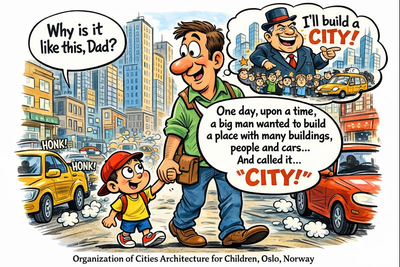
We have a fundamental belief that since the earliest civilizations, cities have been shaped primarily according to adults’ architectural principles while the perspectives and needs of children have largely been overlooked.
To achieve this, we will function as an arena to gather different actors to discuss children architecture and urban development. That will raise awareness among urban stakeholders about the importance of child-centered architecture.
Our aim is to establish a solid platform for integrating children's architectural perspectives into the planning and development of Norwegian cities.This broad and holistic approach requires collaboration across multiple sectors, including state authorities, municipalities, universities, organizations, and research institutions.
Through research, stakeholder engagement, and practical guidance, we enable cities to adopt policies and standards that ensure children are considered equally in planning, architecture, and everyday urban functions.
1. Definition of a child. A child is any person under the age of 18.
2. No discrimination. All children have all these rights, no matter who they are, where they live, what language they speak, what their religion is, what they think, what they look like, if they are a boy or girl, if they have a disability, if they are rich or poor, and no matter who their parents or families are or what their parents or families believe or do. No child should be treated unfairly for any reason.
3. Best interests of the child. When adults make decisions, they should think about how their decisions will affect children. All adults should do what is best for children. Governments should make sure children are protected and looked after by their parents, or by other people when this is needed. Governments should make sure that people and places responsible for looking after children are doing a good job.
4. Making rights real. Governments must do all they can to make sure that every child in their countries can enjoy all the rights in this Convention.
31. Rest, play, culture, artsEvery child has the right to rest, relax, play and to take part in cultural and creative activities.
Agenda
Board Structure
Conferences and Seminars
Our ultimate goal from arranging these activities and events is to work in partnership with all cities and stakeholders to embed children’s architecture into their professional practices contributing to the creation of new and more inclusive urban realities across Norwegian cities. This, in turn, can serve as a catalyst for new pathways in social development, economic growth, and sustainable urban transformation.n and the energy to tackle new challenges with confidence.
International Collaborations
This collaboration can take many forms and methods, including joint initiatives, knowledge exchange, and coordinated action. A key focus is how we collectively contribute to realizing the principles of the United Nations conventions on children within our cities and societies.
We encourage organizations worldwide to join this global initiative and become part of a growing movement dedicated to advancing children’s rights and well-being.
National and International Boards
Since the topic of this organization includes all cities in the world we are planning to establish national boards in other countries to deal with own national organiztion, policies, cases and needs.
We will establish an International board who will gather anually to exchange knowledge, experiences, learnings, and develop international activities.
Research
We encourage researchers and scholars to contribute to this field by developing rigorous and impactful research that advances knowledge and practice. Children’s needs in architecture and urban development remain significantly underexplored, despite their fundamental importance to the quality and sustainability of our cities.
Expanding research in this area is essential to reposition children at the center of spatial planning and to foster more inclusive, responsive, and livable urban environments.
Cities must integrate these rights into their architecture, planning, and functions. Children deserve equal consideration in design, ensuring urban spaces truly serve all ages. To achieve this, cities need dedicated policies for child-inclusive architecture.
The UN Convention on the Rights of the Child (UNCRC) is an important, legally binding agreement signed by 196 countries (as of 12 July 2022) which outlines the fundamental rights of every child, regardless of their race, religion or abilities.
FAQS
What is Children citites?
What is Children citites? Plus icon A movement that promotes inclusive urban planning and architecture that takes children’s needs and rights into account. It advocates for developing city architecture based on children principles equal to the adults to make the city a place for all needs.
Why focus on children in city design?
Children are often overlooked in urban planning. Designing for them ensures more inclusive, healthy, and livable cities for everyone.
What kind of work do you do?
What We conduct research, publish insights, collaborate with other professionals, and advocate for policies that prioritize child-friendly urban spaces..
Are there projects I can learn from?
Plus icon We’re building a portfolio of case studies and ideas. Get in touch to see how others are applying these principles..
Can I get involved?
Yes! Whether you’re an architect, urban planner, educator, government official or simply passionate about building better cities, reach out. We welcome collaboration.
Key Targets
Learning
The city is a space for children to learn
Health
The city provides children with all their health needs
Psychology
The city architecture supports psychology of the children of all ages and conditions
NATURE
The city provides the children with natural environments and landscapes.
Growth
The city provides children with continuous growth possibilities
Safety
The city preserves the safety of children through more careful urban planning
Testimonials
Become a Giver
Become a Host City
We encourage cities to benefit from CAC to develop knowledge and measures that support children architecture in their cities.
Arranging the events in a particular city will provide the city with important scientific platform to discuss the local condition, needed policies, initiatives and projects.
We will help your city to benefit from the event to attract local and international partners and investors by a well-organized marketing media.