When Art Becomes a Tool to Cover the Shortage of Children’s Architecture
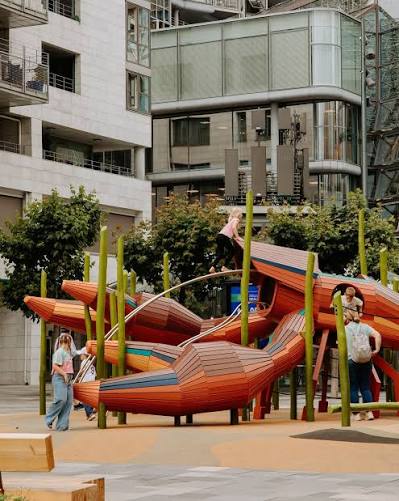
One of the key forces shaping contemporary urban development is the search for economic value. Increasing density is often an important strategy for achieving this.But density also creates pressure on outdoor spaces. More people, more buildings, more activities, and less space available for children.
In many new developments, particularly where ground floors contain mixed-use functions, developers need to demonstrate that children have been considered. A playground is therefore often considered.
Sometimes, developers use art, attractive forms, colours, and innovative playground designs to create the impression that children’s needs have been addressed.
The problem is that an attractive playground can still provide very few meaningful activities.
A beautifully designed object is not necessarily good children’s architecture.
The question should not be:“How beautiful is the playground?”
The question should be:“What can children actually do here?”
Children’s needs should be evaluated through the variation of activities and the different age groups that can use the space.
Can children run, climb, explore, imagine, create, socialize, observe, rest and play in different ways?
Can a 4-year-old use the space differently from a 10-year-old?Can older children and teenagers find a place for themselves?
Too often, urban design is developed first, and children are added afterwards as a variable formed by the created outdoor space
This should be reversed.Children should be considered from the beginning not as an aesthetic addition to the city, but as equal users of the city.
I have been examining this issue through case studies of Aker Brygge and Bjørvika in central Oslo. Both are highly developed urban areas with strong architectural identities, mixed uses, and intensive public spaces. Yet the opportunities provided for children remain relatively limited.
The challenge is therefore not simply to create more beautiful playgrounds.
The challenge is to create richer children’s urban environments.
We have to stop using design as a tool to cover the missing needs of different ages.
And start asking:What kind of urban life do we want children to have?
